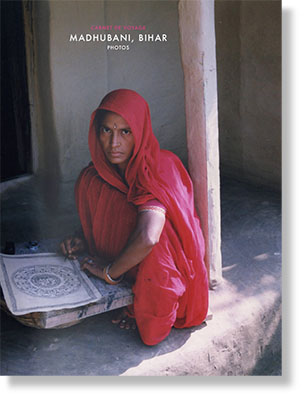
Gallery Frédéric Moisan and Gallery Hervé Perdriolle show:
Jivya Soma Mashe and other painters of the Warli tribe.
Dates: 10 - 15 September 2013
Location: Galerie Frédéric Moisan 72 rue Mazarine 75006 Paris
lundi 9 septembre 2013
Parcours des mondes The Leading International Tribal Art Fair


Parcours des mondes Le salon international des arts premiers
La galerie Frédéric Moisan et la galerie Hervé Perdriolle présentent :
Jivya Soma Mashe et autres peintres de la tribu Warli.
Dates : 10 - 15 septembre 2013
Lieu : Galerie Frédéric Moisan 72 rue Mazarine 75006 Paris
Inde : la nouvelle garde
Source Les Echos par Raghuram Rajan
L’un des premiers domaines à avoir initié ce renouvellement de génération est celui des arts. Pendant de nombreuses années, la littérature indienne a été dominée par une clique écrivant principalement pour un public de niche et la reconnaissance littéraire. Puis, il y a déjà quelques années, un groupe de jeunes écrivains – dont Chetan Bhagat et Amish Tripathi, tous deux anciens banquiers – ont modifié les règles du jeu en écrivant pour le marché de masse. Plutôt que d’écrire pour les critiques littéraires, ils ont commencé à utiliser un langage plus simple, en insérant des tournures de phrase indiennes. Ils ont aussi abordé de nouveaux thèmes : Tripathi a puisé dans la mythologie pour écrire sa trilogie sur la déesse Shiva, tandis que Bhagat s’est intéressé à la vie de la nouvelle classe moyenne indienne, jeune et progressiste. Comme on pouvait s’y attendre, les puristes ont bondi et les critiques les ont ridiculisés. Mais les gens ont acheté leurs livres par millions, et des projets de films ont été signés. Le marché de l’édition s’est donc considérablement élargi et les éditeurs ont été obligés de modifier intégralement leurs stratégies commerciales. Oui, l’économie indienne s’est considérablement ralentie, la roupie s’est effondrée, et les scandales et les manifestations font les gros titres de la presse. Mais au-delà de cette vision négative, une nouvelle génération prend le relais avec de nouvelles idées et de nouvelles perspectives pour l’Inde.
> read more
samedi 7 septembre 2013
The Hour of the Day of the Month of the Season: Jitish Kallat exhibits at Galerie Daniel Templon

Source Art Daily
Galerie Daniel Templon is celebrating the new season with the first ever French solo exhibition of work by Indian artist Jitish Kallat a stimulating voice on the contemporary art scene in recent years. Known for his seminal shows such as 'Public Notice 3', his year-long solo exhibition at the Art Institute of Chicago or photographic installations such as Epilogue with its 22,000 moons made of Indian breads, Jitish Kallat will be taking visitors on an evocative journey through the two Galerie Templon spaces with a complex series of works in mixed media: painting, sculpture, text, photography and video.
> read more
vendredi 6 septembre 2013
Remembering Nasreen

Source Indian Art News by Roobina Karode
Born on 5th September, Teacher’s Day, was incidental to the fact that Nasreen Mohamedi was an extraordinary teacher. Her unique and eccentric presence influenced generations of students at the MSU from 1970s till the late 1980s.How often does one meet a teacher who sensitizes us to the minutest of changes happening around- the presence of breeze, light or movement in Nature as well as built environments? What she taught us in the course on drawing for the two preparatory years was about learning to be alert and attentive to the experiential world around us. Sometimes, we were asked to pick up from our surroundings what we responded to- a stone, a stick, a fragment from an object and draw its qualities through sight, touch, feel and texture while seeking connections beyond isolated objects. While outdoors, we were not learning to compose views of nature as landscapes but were made aware of those poignant details and elements in Nature that one may otherwise not even notice, discover or register. Subsequently, Nasreen also taught us the importance of silent reflection. She was the one who made me aware that the world is too much with us all the time and that it is important to withdraw from it and deeply reflect upon it as well.
These are Buddha's footprints

Source Dawn.com by Alyna Hasan Jaffery
It was the spring of 2012, students flooded in and out of classrooms hunting teachers for assistance with exam preperations and coursework. The ‘curious’ lot, as one of our professor’s aptly put it, was busy taking on extra courses for the last semester of high school. That was when I opted for the art history course and fell in love with it instantly. The romance was short lived – the course only lasted two months. But during those two months, we travelled from Egypt to Mesopotamia, from ancient Greece to the sub-continent, and basically everything in between. It was the course, the animated talks about ancient civilizations and the long hours of research and sifting through reading materials that first prompted me to travel and discover them for myself. My travels took me to the sacred sites at Taxila – a lost land and age, forever reminiscent of a burgeoning cultural heritage.
> read more
mardi 3 septembre 2013
Mumbai’s Gallery Chemould Hits 50

Source The wall Street Journal
“It allowed for expansive and ambitious shows and also allows for excitement in the art space,” she added. It wasn’t just Kekoo and Shireen who were active at Chemould. Khorshed Gandhy played helped bring Warli paintings to Bombay’s art scene. The Warli art form was popularized by Jivya Soma Mashe, whose first exhibition at the gallery was in 1975.
> read more
dimanche 1 septembre 2013
We want to re-connect the present with the past: Hugo Weihe
Source Times of India Interview with International Director of Asian Art, Christie's, New York by Avantika Bhuyan
All art forms are inter-related and evolve over time. For instance, Kalighat painting directly inspired Jamini Roy. Medieval Indian sculpture deeply inspired MF Husain, who was guided by the sense of movement and form. Our goal is to re-connect the present with the past, to demonstrate how artistic tradition is an evolutionary process and showcase Indian art as a continuum.
> read more
samedi 24 août 2013
Osian's launches website on art and culture

Source Times of India by Meenakshi Sinha
From Hindi cinema to Indian modern art, from Asian antiquity to handmade crafts, a website, to be launched on Independence Day, promises plenty of information on many aspects of Indian art and culture. "The free online search-engine, theosianama.com, has been established to help transform the perceptions of Indian and Asian civilizations within the hearts and minds of the Indian and global public. To fall in love with our heritage once again is essential. Knowledge must also take up this responsibility to implement a vast outreach framework," says Nevile Tuli of Osian's.
> read more
Want the arts to flourish? Get educated
Source Livemint by Shoba Narayan
Assume that the planet Mars is colonized; that humans have found a way to sustain life there. Who would we need to get society going? First on the list of people that we would put on the spaceship out to Mars would be the builders and architects of our spaces: city planners, sanitation engineers and urban developers. Next would be the professionals who provide important services: doctors, nurses, fire fighters, school and college teachers, bus and taxi drivers, and retail workers. With each successive spaceship, a new set of professionals would make their way to Mars, imbuing that society with efficiency, order and communication. The final spaceship would carry those people who would give this brave new world on Mars its soul: dancers, musicians, artists, poets, philosophers, thinkers and writers—people who have no obvious “use” in a society but are the bedrock of a civilized world. For many of us, living in a world without the arts is unthinkable. Listening to music helps us connect with our souls; watching and participating in dance gives joy to our spirit; good theatre holds up a mirror to our lives and thoughts; and the visual arts provoke our psyche while quieting it at the same time. Yet, how many Indians are engaged with the arts in a meaningful way? Very few. I reckon that if you ask the average Indian walking on the street whether Mars needs artists, he will scratch his head and say, “not really”. That is the fallacy that those passionate about the arts have to change.
> read more
vendredi 23 août 2013
Indian art scene shows signs of recovery: Expert
Source Business Line by V. Sajeev Kumar
Vadehra says India’s contribution in the world art market has yet to grow to match its potential. “India contributes only 0.5 per cent of the global art market. Latest annual figures peg India’s art market turnover at $ 400 million, when the worldwide figure is $ 65 billion,” he said. This is when India’s GDP stood at 4 per cent of the global GDP. “Our country has to ensure that its art market contribution grows by a similar proportion,” he points out. “Close to 4 per cent of the world’s art market turnover should be from India. It will happen in the next two to five years,” he said. Vadehra, however, notes that lucre wasn’t exactly what prompted him to launch VAG more than a quarter century ago. “In rhose days, India did not have a booming art market. We launched the gallery basically for our love for art,” he recalls.
> read more
Jitish Kallat - Galerie Daniel Templon

Source Artistik Rezo
La galerie Daniel Templon lance la saison en exposant pour la première fois en France le jeune artiste indien Jitish Kallat, l’un des plus prometteurs ayant émergé sur la scène contemporaine ces dernières années. Déjà célèbre pour sa ‘moto-squelette’ (Ignitaurus) ou son installation photographique de 22 000 lunes de pain rond indien (Epilogue), Jitish Kallat propose dans les deux espaces de la galeries Templon un parcours complexe à travers son univers mêlant peinture, sculpture, écriture, photographie et vidéo...
> lire plus
jeudi 1 août 2013
Chandigarh, India, a city designed by Le Corbusier

Source Boston Globe by Anthony Flint
There’s a wonderful branding throughout Chandigarh that reflects the unity and coherence of a city planned all at once, and the promise of utopia. Tidy maps of the sectors appear near most of the rotaries that link the superblocks, complete with a “you are here” dot. The manhole covers are imprinted with the grid of the city — even the doorhandles are distinctive — prompting thieves to try to make off with both custom items to sell on eBay. One additional attraction that Le Corbusier didn’t plan is the Rock Garden, a labyrinth of pathways, ponds and waterfalls, and marvelous sculpture displays made of recycled ceramic, begun by a government worker, Nek Chand, who started creating the park in his spare time. The Rock Garden is a major destination for tourists and Indians alike; Westerners should not be surprised to be asked to pose for pictures, a coveted prize for a local family outing.
> read more
vendredi 19 juillet 2013
Christie’s accélère sa mondialisation avec l’Inde
Source Les Echos par Martine Robert
Contrairement à Sotheby’s, son grand concurrent sur l’échiquier mondial, qui se concentre sur le très haut de gamme, Christie’s a choisi d’investir presque tous les segments de prix et tous les types de biens vendus aux enchères (de l’art aux montres en passant par le vin) sur quasiment tous les continents : après Hong Kong et Dubaï, la maison détenue par la famille Pinault organisera en septembre, sans partenaire local, ses premières adjudications à Shanghaï, poumon économique de la Chine continentale, puis en décembre à Bombay, axé cette fois sur l’art indien, annonce dans une interview aux « Echos » Steven P. Murphy , son directeur général.
> lire plus
mercredi 17 juillet 2013
Asia Pacific's art market comes of age

Source The Guardian by Roxana Azimi and Florence de Changy
Asia's emergence on the artistic scene is therefore more that a mere geographic shift. Western sellers are getting in touch with Asian buyers and this is triggering a radical overhaul reminiscent of the migration of the art markets from the European capitals to New York in the early 20th century and the dominance of the American schools that followed. Asia is as diverse as it is vast and we may soon expect a multitude of Asian schools, art fairs and new collectors endeavouring to show their supremacy to the rest of the world.
> read more
Christie's to become first international house to hold auction in India in December 2013
Source Times of India by Archana Khare Ghose
The decision to hold an auction of Indian art on Indian soil comes nearly two decades since the 247-year-old auction house opened its office in the country, in Mumbai, in 1994. The development comes close on the heels of another important move by Christie's in the region — it recently announced that in September 2013, it will become the first international auction house to operate independently in mainland China with a sale in Shanghai.
> read more
lundi 8 juillet 2013
Mithila Painting œuvres rares à la galerie Hervé Perdriolle
Mahasundari Devi, la dernière des grandes figures historiques du Mithila Painting vient de décéder à l'âge de 92 ans. Le World Museum de Liverpool expose actuellement quelques uns de ses dessins et de ceux de sa petite fille Pushpa Kumari, laquelle renouvelle audacieusement cet art ancestral. Venez découvrir à la galerie Hervé Perdriolle quelques œuvres historiques de ces femmes peintres.
> lire plus
jeudi 4 juillet 2013
Doyenne of Mithila painting Mahasundari Devi dies

Source Times of India
Mahasundari Devi, the doyenne of Mithila painting, breathed her last at her native village, Ranti, near Madhubani on Thursday morning. Her last rites will be performed on Friday, said her eldest son, Bipin Kumar Das. She has left behind a large family including three sons, daughters and grandchildren to mourn her death.
> read more
mercredi 3 juillet 2013
Charles Ratton, un marchand audacieux

Source Le Quotidien des Arts par Sarah Hugounenq
« C’est par une grande audace du goût que l’on est venu à considérer ces idoles nègres comme de véritables œuvres d’art », écrivait Guillaume Apollinaire en 1917. L’un des principaux acteurs de cette « audace du goût » fut sans conteste l’antiquaire Charles Ratton (1897- 1986), dont le musée du quai Branly, à Paris, tente de dresser le portrait. Mais, contrairement à ce que laisse supposer son titre, « Charles Ratton, l’invention des arts “primitifs” », l’exposition se borne à offrir un panorama des expositions qu’il a vues, organisées ou pour lesquelles il a prêté des objets.
> lire plus
mardi 2 juillet 2013
ArtAsiaPacific July/August 2013

In May, we launched ArtAsiaPacific’s special 20th birthday issue, which, instead of looking back on our past, gazed ahead to the next 20 years. However, since we started planning our celebratory issue well over a year ago, we couldn’t help but discuss the important artistic legacies that have shaped contemporary art in Asia, the Middle East and the Pacific.
For our July/August edition, we consider both these seminal figures, as well as the younger generation of artists who are the protagonists in the cultural histories of Asia.
> read more
vendredi 28 juin 2013
All the Trappings of Victorious Headhunters

Source The New York Times by Ken Johnson
It would be hard to imagine a more misleading title than “Fiercely Modern: Art of the Naga Warrior,” the name of a show at the Rubin Museum of Art. The Naga, a diverse collection of peoples speaking similar languages and residing in a mountainous area in northeastern India, certainly were fierce. Headhunting was one of their prized pursuits. But they were far from modern by present-day standards. In fact, the culture of the Naga was nearly destroyed by modern Europeans. First came mid-19-century subjugation by the British, who wanted to stop the irritation of headhunting raids on neighboring Indian territories. Then American Baptist missionaries invaded, eventually succeeding in almost totally suppressing the Naga’s “satanic” practices and converting nearly all of the population to nominal Christianity.
> read more
jeudi 27 juin 2013
Generation to generation, Indian contemporary art on film

Source Art radar Asia
The world premiere of To Let the World In, a two-part documentary film featuring three generations of India’s visual artists by director and cinematographer Avijit Mukul Kishore, debuted at the Sheffield Doc/Fest, in South Yorkshire, UK on 13 and 14 June 2013.
> read more
The 10 Most Expensive Artworks Ever Purchased at Auction

Source Mutual Art
When considering the question of who is the greatest artist of all time, the laurels could go to Pablo Picasso who sweeps the premium category with three paintings in the 10 most expensive artworks purchased at auction including #2 – Nude Green Leaves and Bust (1932), #3 – Garçon à la Pipe (1905), and #5 – Dora Maar au Chat (1941). The list also includes a relative newcomer in the #1 slot, Edvard Munch’s The Scream (1895) purchased in May 2012 at Sotheby’s New York by financier Leon Black for almost $120,000,000. This is one of four versions of the famous howl, and the only one remaining in private hands.
> read more
mercredi 19 juin 2013
Les nouvelles pistes des "Corps subtils" au LaM

Source Le Quotidien de l'Art par Roxana Azimi
Voilà un accrochage qui bruit de plaisir et palpite d'énigmes, qui s'autorise du hors piste, à une éraflure de l'abîme, sans jamais y glisser. Basé sur le dialogue entre les deux collections d'art brut et d'art tantrique...
> lire plus
mardi 18 juin 2013
Neo-Miniaturist Imran Qureshi on His Rooftop Painting for the Met

Source Art Info by Sehba Mohammad
When this imagery first appeared in your work it had a deep blue tone. Why did you change it to a blood red? "In 2009 and 2010, Lahore, where I live, was a main target for Al-Qaeda. There were bomb attacks almost twice a week. They destroyed the city. There was a blast near my house. I had very nostalgic connection to one place I used to go with my wife, Aisha, a market that had been full of life. After this blast it was transformed into a bloody landscape. That was when I switched to using a blood-red tone."
> read more
Inscription à :
Articles (Atom)

 Articles