Source Aware par Marjorie Micucci
Née en 1978 à Mumbai où elle vit et travaille1, l’artiste indienne Hemali Bhuta présente au Centre international d’art et du paysage de Vassivière (Limousin) sa première exposition personnelle en Europe2 : Subarnarekha (La ligne d’or). Le titre double renvoie à une dualité et à une jonction de paysages et de géologies, entre le nord-est de l’Inde où coule vers le golfe du Bengale la rivière Subarnarekha3, qui fut une zone d’exploitation aurifère, et cette région limousine, elle aussi connue pour son activité d’extraction d’or et où ont été créés artificiellement l’île et le lac de Vassivière.
> lire plus
mercredi 28 février 2018
Hemali Bhuta, ou l'exposition comme paysage à ciel ouvert


mardi 27 février 2018
Exposition : Graffitis et art tribal Made in India

Source Marie-Claire par Camille Sanchez
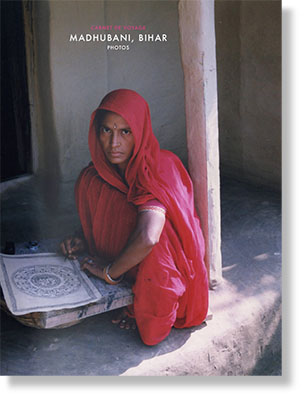
Durant la moisson entre octobre et décembre, avec un chiffon ou une brindille de l’arbre local Sal, ces amatrices d’art célèbrent la fertilité et l’abondance autour du style Sohrai en dessinant des éléphants, des plantes et le dieu mâle de Pashupati sur le dos d’un taureau. Le style Khovar, lui, est un art nuptial. Dans cette société à l’origine matriarcale, le mari passe la nuit de noces dans la maison de sa femme. Le décor est constitué de plantes, et d’animaux de la forêt. Les symboles atypiques comme des losanges ou des coeurs, en passant par des serpents arc-en-ciel et autres créatures animales, ont retenu l’attention de la photographe allemande Deidi von Schaewen.
> lire plus
dimanche 25 février 2018
Art Organic

Source DNA by Gargi Gupta
Benitha Perciyal is speaking to a journalist at India Art Fair 2018’s Gallery Veda booth, when a passing spectator steps up to her. “You look like a part of that work,” he says, pointing to the sculpture titled I resist, therefore I exist, prominently displayed near the front. “I saw it and knew you were the artist. I was at your show last year at Nature Morte gallery and saw those works. They are exquisite,” he adds, shaking her hand vigorously. Perciyal is moved, clearly. “This,” she says “is what keeps you alive, this is what makes you go to another point (artistically), not the price (of artworks)."
> read more
French Connection...

Source DNA by Gargi Gupta
V Nageshkar was the first Indian artist to travel to France to study art. He spent five years (1930-35) at École Nationale Supérieure des Beaux-Arts, France's premier art school. How this obscure artist, who was born and brought up in Kolhapur, ended up in Paris is not known, but a few of his paintings that survive show a distinct touch of Gauguin. Undoubtedly, it would have been the influence of the intense churn in art-making practices underway in Paris at the time, with several movements such as Post-Impressionism, Expressionism, Fauvism, Dadaism and Cubism jostling for attention.
> read more
Story of the Experimenter

Source DNA by Gargi Gupta
Priyanka Raja of Experimenter is happy. It’s only the second day of India Art Fair, 2018, and the Kolkata-based gallery has sold 80% of its works. “I think we’re in a good place,” she says. That statement could well be extended to apply to Experimenter’s track record over the nine years it has been around. For a young gallery located in the eastern metropolis – once an important arts centre, but now more or less a backwater for contemporary art – and one with a very limited, focused programme, Experimenter has now established itself internationally as a leading purveyor of cutting-edge contemporary art.
> read more
While everyone was fixated on India Art Fair, an anti-art fair stole the show with its energy

Source Scroll In by Chanpreet Khurana
In late January or early February each year, artists, gallerists, curators, art collectors and general visitors interested to see art swoop in on New Delhi. They often come for the India Art Fair, and stay on to attend the multiple collateral events and art exhibitions that run in sync with the fair. This year, a new event positioned itself as an alternative to the art fair. The idea for it was seeded about four months ago, in late 2017, when Anant Ahuja moved from Mumbai to Delhi to start Bridge Studio. In Mumbai, Ahuja had been part of Taxi Fabric, which used taxi seats as a canvas to take art into a very accessible, very public space, and Design Fabric, a platform for dialogue and events.
> read more
vendredi 23 février 2018
New Museum Triennial Looks Great, but Plays It Safe

Source New York Times by Holland Cotter
The New Museum’s fourth triennial exhibition, “Songs for Sabotage,” is the smallest, tightest edition of the show so far. Immaculately installed, it’s also the best looking. Less admirably, it’s the safest. There’s a lot of good work, real discoveries. But in a politically demanding time, the show keeps its voice low, acts as if ambiguity and discretion were automatically virtues. In an era when the market rules, the show puts most of its money on the kind of work — easily displayable things — that art fairs suck up. As if to justify the reference to sabotage in the title, there are examples of activist, or activist-minded art. Anupam Roy from New Delhi, a member of the Communist Party of India (Marxist-Leninist) Liberation, papers a room with Expressionist drawings assailing the reactionary climate in his country today.
> read more
jeudi 22 février 2018
Same, but different: the 10th India Art Fair

Source Ocula by Gayatri Uppal
At Nature Morte, images from Gauri Gill's 'Acts of Appearance' series were on view; first exhibited at documenta 14 in Kassel in 2017. Working with the Bahora crafts community in Maharashtra, Gill commissioned a few families to create masks that reflect their contemporary realities, and photographed these mask makers, and other volunteers from the village community, wearing their creations. This relationship between craft and art practice was also a focus at A Search in Five Directions—an exhibition on textiles presented by the National Handicrafts and Handlooms Museum in collaboration with Devi Art Foundation (21 January–31 March 2018). A tribute to the late Martand Singh, who spearheaded a significant textile revival movement in the 1980s and 1990s, the show references seven 'Visvakarma' exhibitions from that period, which documented traditional textile techniques and worked with weavers and craftspeople to adapt, innovate and evolve these techniques for contemporary times.
> read more
India’s Art Market Is Poised for Liftoff—But Haven’t We Heard This Before?

Source ArtnetNews by Melanie Gerlis
Another sign that India’s art market boom might not be a flash in the pan is the growing number of international museum shows of work by artists from the region. In its first two years, New York’s Met Breuer mounted as many solo shows of Indian artists (Raghubir Singh and Nasreen Mohamedi). In 2016, London’s Tate Modern had a solo show of Bhupen Khakhar, whose work fetched a record £1.1 million at a sale of the late Howard Hodgkin’s collection last year. Closer to home, India’s art traders are bullish about an enthusiastic mass market of potentially younger buyers who are embracing technology at breakneck speed. One of the biggest success stories has been StoryLTD, an online-only, fixed-price, or no-reserve e-commerce offering that Saffronart launched in 2012 as a way to meet the challenges of the global economic recession.
> read more
Highlights From The 2018 India Art Fair

Source Hong Kong Tattler by Aaina Bhargava
The commitment to presenting the highest quality Indian art in respect to country’s history, contemporaneity and future talent, is evident in this year’s India Art Fair. Not to mention the increase in non-profit and public institutions that participated in this year's fair—which was higher than any year before—which continues to and form connections between the artistic community and the public, giving international visitors and those new to the world of Indian art a solid introduction. Through representation from neighbouring South Asian Nations is slightly inadequate, Jagpal’s determination to use the fair as an “opportunity to explore and test ideas to shape the long-term future of India Art Fair, to ensure that it reflects the cultural diversity and distinct identity of the region,” shows promise of expanded regional focus in the future, bolstering the local and international presence of South Asian art.
> read more
mercredi 21 février 2018
7 things we learnt from the 10th India Art Fair

Source Livemint by Rahul Kumar
An art fair is a commercial space, and transactions are important for the key clients of the fair—the galleries. Almost all the galleries I spoke to confirmed that they were satisfied with the business they generated in the 4 days at the fair. Chatterjee & Lal and Jhaveri Contemporary were two returning galleries this year. “We are pleased to have engaged with new collectors at this edition,” said Mortimer Chatterjee of Chatterjee & Lal. Visiting museum personnel and patrons from abroad allowed for increased opportunities for international placement of works of art. “It was heartening to see interest from foreign buyers,” said Rasika Kajaria of Gallery Exhibit-320.
> read more
mardi 20 février 2018
More people are collecting art now than 10 years ago, says Yamini Mehta of Sotheby’s

Source The Indian Express by Vandana Kalra
The Indian art market did probably bottom out a bit in 2009 but what you end up seeing is a filtration process. The works of the modernists and established artists came back much more quickly. There are many more people who are collecting art now than 10 years ago. Wider group of collectors also means more stability. People are not just buying a name, but also educating themselves about the artists. In India, a lot of works are still too inexpensive when you compare to the other markets. Newer groups of artists are being auctioned and getting high prices.
> read more
Rare Raja Ravi Verma works may fetch $400,000-$600,000 at Sotheby's auction

Source Business Standard
Following in the footsteps of Untitled (Damayanti), sold last season for a remarkable price of $1.7 million, Ravi Varma's Tillottama carries a pre-sale estimate of $400-600,000, the organisers said. Painted circa 1896, the luminescent portrait of Tillottama, a celestial nymph from Hindu mythology, is characteristic of the artist's oeuvre; by combining western Academic Realism with markedly Indian subjects, and unexpected combinations of colours, Ravi Varma's works of art remain timeless and uniquely his.
> read more
dimanche 18 février 2018
Of high heels and high art

Source The Hindu by Gayatri Rangachari Shah
Cool sneakers or boots for the day and high heels at night are my uniform for art fairs and this year in Delhi was no different. Wise footwear is critical since, across the world, these fairs are celebrated for their art, and their relentless nights on the town. Last week, the 10th edition of the India Art Fair in Delhi had both in spades. After the MCH Group, which owns Art Basel, purchased a majority stake two years ago, there was considerable anticipation as to what direction the fair would take. Well, its new director, Jagdip Jaspal, who previously worked at the UK’s Tate museum, is committed to showing the best Indian art galleries and stayed true to her word. Many gallerist friends like Priya and Amrita Jhaveri of Jhaveri Contemporary, Mortimer Chatterjee and Tara Lal of Chatterjee & Lal, and Bhavna Kakkar of Latitude 28, who had sat the fair out previously, had returned this year.
> read more
Delhi’s new-look India Art Fair
Source Financial Times by Rachel Spence
Now in its tenth year, the art fair, which was previously known as the India Art Summit, has had its highs and lows. Its inception coincided with the global crash of 2008 that burst India’s financial boom. For a while faith in the art market stayed alive. In 2013, Christie’s even began to hold auctions in Mumbai. But last year, as prices flatlined, Christie’s pulled out, and the fair, which had garnered a reputation for chaotic halls and uneven quality, lost the patronage of leading Indian spaces and the handful of top foreign galleries, such as White Cube and Lisson, who once exhibited. This year however, fresh winds blew. Despite gridlocked traffic and smog-stained skies, the spacious elegant exhibition halls and serene, grey-carpeted piazza made for a mood of serene commercial optimism.
> read more
Change is the only constant: Images that symbolise contemporary experience

Source Sunday Guardian by Bhumika Popli
If there is one exhibition you must see this month, let that be Mutations. Being hosted at Delhi’s 24, Jor Bagh gallery, the photography exhibition is on view till 25 February. This show is a side event of the recently-concluded India Art Fair, and is a part of an ongoing four-month-long cultural programme between India and France called “Bonjour India”. Various techniques and forms of photography are on display at the show. The 16 Indian and French photographers have presented portraits, landscapes, digital montages, collages, mixed-media works, as well as samples of staged and alternative photography.
> read more
Reimagining the idea of India

Source The Tribune by Monica Arora
Considering that art is actually derived from life, should artists create art for art’s sake or should they use the medium to convey a message? Indeed, it is vociferous assertions like Riyas Komu’s art which are echoing the sentiments of the people of the Indian subcontinent and are becoming defenders of our ability to express and live freely. These are voices of dissent, of defiance and non-compliance, of self-belief and upholding values that we, as a democratic, sovereign and secular republic, were promised after the independence from imperial rule. And yet, with the state inflicting several sanctions, prohibitions and dos and don’ts and other cultural restrictions, one discovers the many voices from the art fraternity that have taken the onus of expressing the voice of the people in this suppressive atmosphere.
> read more
mardi 13 février 2018
Anju Dodiya on art, empathy and her latest exhibition, The Air Is A Mill Of Hooks

Source First Post by Manik Sharma
Few contemporary artists in India have the kind of reputation that Anju Dodiya does, given she has a solo exhibition running parallel to the India Art Fair. Fewer still, are as reclusive and self-aware. For those aware of her previous works, the idea of the self is almost a given. Dodiya has been known to explore the idea of pain, the very nature and forms of it. In her 17th solo show, titled ‘The Air is a Mill of Hooks’, Dodiya steps outside the body and examines the space within which Sylvia Plath’s poem ‘Mystic’ — that gives the exhibition its name — was born.
> read more
Christie’s to unveil South Asian modern masterpieces and contemporary art in New York

Source Architectural Digest by Uma Nair
Christie’s upcoming March sale of South Asian Modern + Contemporary Art during the Asian Art Week, New York, includes over 70 lots and is expected to realize in excess of $10 million. The sale features modern masterpieces by celebrated artists such as Sayed Haider Raza, Tyeb Mehta, and Vasudeo S. Gaitonde, alongside works by contemporary artists.
> read more
Refugees, human displacement dominate major Indian art fair

Source New York Daily News by The Associated Press
As you enter the maze, painted panels with portraits of suffering refugees line your path. The sound of crashing waves fills your ears. Light flickers. This is "The Flow," an art installation by New Delhi-based artist Subba Ghosh, a work inspired by the world's ongoing refugee crisis, and the millions of people driven from their homes by conflict and poverty. Human displacement, the suffering of refugees and the notion of identity dominated the 2018 India Art Fair, an important platform for contemporary artists that provides a carefully curated glimpse into the South Asian art scene through the years. The themes are universal, the artistic expressions deeply personal.
> read more
India Art Fair Makes an Unorthodox Demand of Exhibitors—and It Pays Off

Source Artnet News by Skye Arundhati Thomas
Yamini Mehta, Sotheby’s international head for Indian and South Asian art, said this year’s fair comes at a fertile moment in the country’s art market. “A lot of the speculators are now out of the market, and collectors are instead buying with the idea of owning a work for at least a generation,” she said. “This has built stability in the marketplace, whereas before you had works mostly staying in their crates and moving from one warehouse to another for years.”
> read more
India Art Fair 2018: Challenging the male gaze

Source Livemint by Tanuj Kumar and Radhika Iyengar
One of the themes that particularly stood out at the 10th India Art Fair was seen in artworks that explored issues of gender equality and women’s rights. It may not be premeditated, but across galleries there were works that questioned established gender roles, attacked patriarchy or mocked the male gaze. In the post-Weinstein era, some works that were made long ago, assumed a new meaning and interpretation.
> read more
Frame of Thought

Source The Indian Express by Damini Ralleigh
Most of the work, however, was sold on the first day, during a preview for select audience that the gallerists admit have been carefully determined. Many seemed thrilled at the widening of the collectors’ group, stating that during the IAF they were able to establish contact with new buyers. “The audience at IAF has changed dramatically over the last nine years that we have been exhibiting here. The management seems keen to bring a certain kind of audience to benefit the galleries and they have been able to do that cleverly,” says Pratik Raja of Experimenter, who, through the art fair, has sold works to the Kiran Nader Museum of Art and Devi Art Foundation, and some international buyers, “conversations with whom are still afoot”.
> read more
lundi 12 février 2018
Prolongation jusqu'au 15 février

EXPOSITION "AFFORDABLE CURIOSITIES" 102 RUE DU CHERCHE-MIDI PARIS 75006 JUSQU'AU 15 FEVRIER TOUS LES JOURS DE 11H A 20H
IN MAPU’S MEMORY: DISCOVER INDIGENOUS HANDLOOMS IN DELHI AT THIS EXHIBITION

Source Verve
Now, Devi Art Foundation, and the National Handicrafts and Handlooms Museum in New Delhi, is hosting the exhibition A Search In Five Directions — organised in memory of Mapu, drawing from his Vishwakarma series. Curated by industry stalwarts Rakesh Thakore, Rta Kapur Chishti and Rahul Jain, the showcase includes creations that amply ‘reflect fresh explorations in technique and aesthetics’. This mammoth initiative is sure to help new viewers discover textures, weaves and dyes of India through several interesting and enlightening exhibits.
> read more
Inscription à :
Articles (Atom)

 Articles